


Sometimes the very skills that make us great at our jobs can get in the way of collaboration.
Many leaders I work with excel at solving problems and making decisions. They’re quick to spot a solution and get things moving. But once they’ve found an answer they like, it can be surprisingly hard to let go.
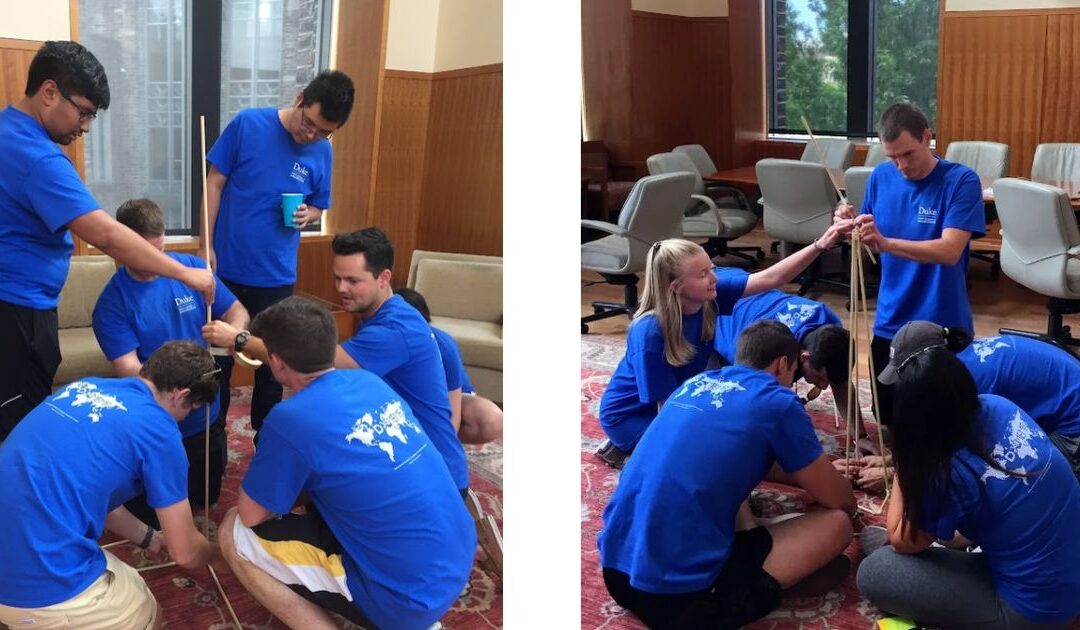
I see this in an activity I facilitate called Identical Structures. Two groups receive the same materials—dowels of varying lengths and masking tape – and a challenge: build identical structures, each 4′ x 4′ x 4′. They’re in separate rooms, unable to see each other’s work, and can communicate only by phone. Before they’re allowed to talk, each team gets 20 minutes to plan.
You’d think the planning time would help, but it often does the opposite.
By the time they connect, each team has discussed possibilities, made decisions, and grown attached to a plan they’re proud of. So instead of starting with “What could we build?” they’re thinking, “How do I get you to understand what we already figured out?”
They’re not collaborating. They’re selling.
The biggest barrier isn’t the phone or the distance. It’s their attachment to the plans they’ve worked so hard to develop.
Sound familiar? We do this at work all the time. A leader develops a solution before asking for input. Two departments arrive at a meeting ready to advocate for their own approaches. Someone spends weeks perfecting a proposal, then announces, “I’d love your thoughts!” (As long as those thoughts don’t require changing the proposal, of course.)
I’ve caught myself doing this, too. Sometimes I become attached to an approach before I’ve fully explored the problem. Clients sometimes come to me knowing exactly what workshop they want or what experience their team needs. And they may be right! But part of my job is to help us explore what’s really going on before settling on a solution.
The problem isn’t having a good idea. It’s becoming so attached to it that we stop considering other possibilities.
And we don’t always notice when that happens. We think we’re listening, but we’re preparing our response. We ask questions to expose weaknesses rather than explore someone else’s thinking. “Yes, but…” replaces “Tell me more.”
Without realizing it, we’ve shifted from curiosity to advocacy.
Of course, experience and expertise matter; strong opinions can make collaboration richer. But collaborating requires a different mindset than solving problems alone: staying curious long enough to discover what others see, know, and imagine that we might not.
Sometimes that means being willing to set aside an idea we’re pretty darn proud of, not because it’s wrong, but because something even better could emerge.
So how do we catch ourselves?
The next time someone suggests a different approach, notice your reaction. Do you immediately want to explain why yours is better? Are you listening to understand their thinking, or waiting to make your case? Do you feel defensive when they challenge an assumption?
That’s your cue to notice when curiosity has turned into a need to be right.
Instead of defending your idea, ask a genuinely curious question: “Help me understand how you’re thinking about this,” or “What are you seeing that I might not be?”
Then listen for something valuable before explaining your own perspective. What might become possible if you combined the best of both approaches?
You don’t have to abandon your expertise or agree. Just make room for something you haven’t considered.
Here’s my challenge: In your next collaborative conversation, catch yourself at the moment you feel compelled to defend your idea. Pause, ask one genuinely curious question, and see what new possibilities emerge.
The goal of collaboration isn’t to prove you brought the best idea into the room. It’s to discover whether there’s an even better one you can create together.
Your first idea might be brilliant. Just don’t let it be the last idea you’re willing to consider.
Recent Comments